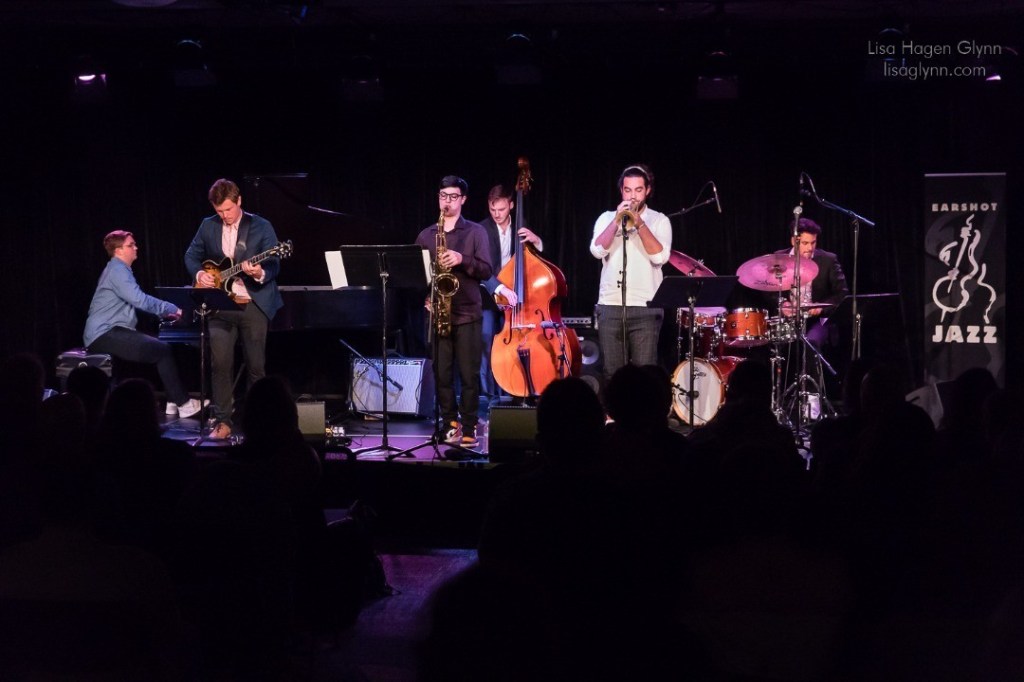
It’s around 1 a.m. in mid-2020. In rural Alaska, five young musicians sit in a spacious airplane hangar; almost as spacious as the snowy landscape outside. With the pandemic raging, they’ve converted the hangar into a makeshift studio. Borrowed recording equipment and instruments lay scattered all around. For the past five hours, they’ve been recording seven compositions that, at this point, have been performed solely over YouTube livestreams. But in just a few months, this will no longer be the case. Come 2021, the group will have played their first live show, released their first album, and given themselves a name: Meridian Odyssey.
In just under three years together, Meridian Odyssey has quickly become one of the most ubiquitous bands in the Seattle jazz scene. They’ve performed in the Earshot Jazz Festival, received airplay on KNKX and KEXP, embarked on two tours, and been recognized by The Seattle Times as having released some of the top records of 2021 and 2022. Quite a list of accomplishments for a band that’s still relatively new–but Meridian Odyssey’s real origins go much further back than COVID lockdowns.
After moving from the Bay Area to study at Cornish College of the Arts, drummer Xavier Lecouturier and pianist/keyboardist Dylan Hayes met bassist Ben Feldman–who was still in high school at the time–before connecting with guitarist Martin Budde soon after. Feldman introduced the group to trumpeter Noah Halpern and saxophonist Santosh Sharma, both of whom he had known since middle school.
The first gig closest to their final configuration, Feldman recalls, was with the Dylan Hayes Electric Band; one that he describes as “kind of a disaster.”
“It was one of the worst gigs I’ve ever done,” agrees Hayes. “From the very first note, it was just a disaster. We couldn’t even speak to each other the next day. It was that bad.”
Time has seemed to heal all wounds for the group, seeing as they’ve now released two records together. Meridian Odyssey’s 2021 debut, Second Wave, came about in the midst of COVID lockdown, when Lecouturier and Budde hunkered down at Budde’s family home in Big Lake, Alaska. With no gigs in the foreseeable future, the two took matters into their own hands.
“We had this idea to do a livestream project, so we got a bunch of gear and started figuring out logistics and then got in touch with everybody,” says Budde. “Everyone flew up to Alaska to hang out and to play this livestream thing. Everyone was doing it, and because of the pandemic, we figured ‘oh, we’ll do a livestream project as well.’ So it was just for that purpose, to do a livestream, and we ended up doing a small in-person concert as well.”
These monthly livestreams–dubbed “The Hangar Sessions” in reference to their unique location of the airplane hangar in Budde’s home–ended up being where many of Meridian Odyssey’s compositions were premiered. However, the group had no intent of releasing them as an album until the last night of their stay in Alaska. Feldman tells me:
“…on the last day that we were all up in Alaska, we were like, ‘hey, why don’t we try recording this tonight?’ We set up all of this recording equipment, and Xavier and Martin were lent this giant mixing board and we had all these mics. We set up in the airplane hangar, and then on the last night, we spent from 8:00 p.m. to 1:00 a.m. recording these songs. Then we heard the recordings back and we were all super hyped about it. Then we were like, ‘yeah, let’s put this out.’”
Released in January 2021 on Origin Records, Second Wave was one of the most well-received local jazz releases of the year. For many, it cemented Meridian Odyssey as a band to keep an eye on, leading the group to return to the airplane hangar a year later. This time, they went in with a new member–Halpern on trumpet–and the end goal of finishing a second album. Gone was the spontaneous nature of Second Wave, having been replaced by a planned-out recording process and a completely new mindset, which Sharma described to me.
“You just think about writing differently when you’re thinking about creating an album instead of just playing with people,” he says. “We knew what we were going to do recording-wise a lot better too; we created all this isolation for the drums and horns. The mentality was different. It felt more serious recording that record than the first one, which was more like hanging out and fun. This second one was more like ‘ok, we kind of do have an agenda. This is what we’re gonna do.’”
Earthshine, Meridian Odyssey’s second record, took on a far more cohesive, album-y feel than Second Wave, which stuck out to me as one of the main differences between the two records. This was no accident–Feldman says, “We did a few shows before we recorded Earthshine, so we were experimenting with intros and transitions between songs, and several of those made it onto the album [“In Front of the Mirror” and “Reflecting”]. We figured out an order that we really liked with the songs where we felt like one song really flowed into the next and there was no point where two like songs are next to each other. We really wanted it to be a journey.”
Sharma adds, “We also just happened to have more variety in tone, so it helped break up monotony and create more unique moments throughout the record.”
It might come as a surprise that, with their big aspirations for Earthshine, the group decided to once again self-record in the airplane hangar rather than head into a professional recording studio. However, for Meridian Odyssey, the hangar and the surrounding territory of Big Lake have become a sort of headquarters, where creativity flows in ways it can’t in a bustling city. Budde, who grew up in the area, compares it to “a really, really rural part of Eastern Washington or something but even more rural.” He goes on to say, “It’s cool because it’s really beautiful and there’s a lack of distraction in any way. There’s nothing going on, there’s no people or stuff to do, so you can just focus on one thing for a really long time. I think that’s the most special thing about that place. You feel really free and relaxed, and you can rehearse for 5 days straight and not think anything of it because you don’t feel like you’re missing out on anything.”

Unfortunately, for the band, performing and recording opportunities can be scarce. Halpern, Sharma, and Feldman live in New York, while Lecouturier, Budde, and Hayes live in Seattle. But despite usually being on different coasts, Meridian Odyssey has never lost its camaraderie and ability to just hang out together. In my conversation with the group, this sense of friendship came up frequently when discussing what makes the band special.
Budde reflects, “There wasn’t anything stifling about it, musically, from the beginning. It was just really fun to hang. I think that element is a crucial part of the identity of the band. It is kind of humorous. People are really serious about music, and everyone writes really hard, really cool, really intense music, and then there’s also that element of just hanging and having a good time and trying stuff out and seeing what happens.”
Adding on, Halpern says, “It’s almost like the music is a side effect of the hang. Not that it comes second, but all the fair play socially affects the music in a positive way. Even if it’s negative social interplay. Just the meshing, developing the empathy, developing the feel for each other, how we work. I think it goes a long way. You can’t really teach it or force it. It just has to happen naturally.”
When asked about their future ambitions for Meridian Odyssey, the band speaks of European jazz festivals, an East Coast tour, and more shows along the West Coast. Additionally, they plan to record new music sometime in 2023. But right now, with the members being on opposite sides of the country, you’ll have to catch them gigging around their respective cities with other groups. This should prove pretty easy–walk into any jazz club in the area, and chances are you’ll find someone from Meridian Odyssey playing or just hanging out. Those in Seattle should check out Hayes’ residency at the Sea Monster Lounge, which begins February 23rd and continues every 4th Thursday from 10 p.m.-1 a.m.
For such young musicians, Meridian Odyssey’s members are in considerably high demand, frequently gigging with top dogs in the Seattle and New York jazz scenes. But to them, this is nothing new. Budde recalls his experience as a new musician in the Seattle scene, saying, “…when I moved here 7 years ago, I instantly was able to play gigs. I wasn’t that good or anything, but I still got to play. If you’re in Berklee [College of Music] in Boston or something, you probably wouldn’t get to play gigs. If you move there to go study jazz or music, there’s so many other people and there’s not as many real gigs relative to the amount of people that are really good or are studying music. So that’s kinda cool, playing out, playing live music. There’s gigs to be had here–at least that’s been my experience.”
Halpern continues, “I’ve lived in New York for a second, but part of what I love about the Seattle scene is that there’s space for things that are not necessarily the most normal or ‘the best.’ There’s space for people to just come up with things and let it be what it is. I’m just comparing it to New York where it often feels like if you want to get the gig, you gotta play a certain way.”
“I was playing with adults when I was in middle school,” says Sharma. “That was amazing, to be able to play with older people when I was that young. If I was in New York, that probably wouldn’t have happened.”
Feldman agrees, adding, “In Seattle, you can just get together with your friends, mess around, and come up with some creative music together. There’s not that same kind of pressure.”
Meridian Odyssey will undoubtedly make a significant mark on the Seattle music scene as they continue on their artistic trajectory. They bring an incredible amount of musical prowess to the stage and a similarly incredible amount of wisdom to conversation. Before our interview came to a close, I asked the members what they would say to aspiring young musicians and creatives.
Sharma: “You gotta love it if you wanna do it, you really gotta love it. And if you really love it, I think all your problems will be solved eventually. Finding good teachers, finding a community, those are two of the most important things. Without those, you can’t improve. You need to find people your age or around your age and then find some people older than you that can be mentors. Always ask questions and be ready to learn. If you really enjoy doing it, then I don’t think you’ll have any issues.”
Hayes: “Also find a way to be financially stable. Maybe get into teaching; that’s a good way to make money as a musician and it’s rewarding too. And don’t put yourself down or beat yourself up if you did something like mess up on a gig. Treat other people with respect. That’s a given. Professionalism is possible with your charts, your notation skills, because that’s the first impression that people will see of you.”
Budde: “Just not really stopping is a huge thing too. Just keep going. Have a good gig and a bad gig, think you played well, think you played poorly, whatever. Have people compliment you, have people tell you you’re terrible. It all happens, but you keep going with whatever you’re doing and eventually you’re gonna get somewhere. For me, that’s been the biggest lesson of all. Just keep going and doing things and trying your best.”
Feldman: “Not sweating little stuff. I feel like, especially as a young musician, it’s easy to get caught up in how much you feel like everything matters and all your mistakes matter. At the end of the day, we’re all gonna die in the end. It means a lot, and music’s so important and transformative, but it’s not gonna kill anyone.”
Halpern: “Believe in your shit, even if other people hate it. You’re doing a lot more good than bad by playing music. It’s an opportunity to lift people up. It’s an opportunity to bring people into a higher space, into a higher level of consciousness.”
Follow Meridian Odyssey on Instagram @meridianodyssey to keep up with new releases, upcoming shows, and other announcements. You can also check out their website to join their mailing list and find links to their music.
 The On Ramp